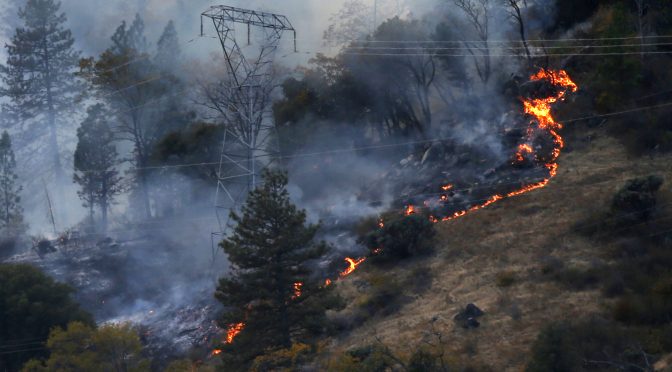
Wildfires Are Now a Year-Round Threat
Across North America, wildfires have escalated from seasonal risks to persistent, year-round threats. Fueled by hotter, drier conditions and prolonged droughts, they now occur with greater frequency, intensity, and unpredictability. The impact on lives, communities, ecosystems – and the grid infrastructure that supports them – is profound.
In this new normal, utilities face a crucial challenge: How can we build an electric grid that is not only more robust but also substantially safer?
Beyond Traditional Risk Mitigation
For years, utilities have leaned on a variety of wildfire mitigation strategies. Vegetation management remains foundational, and Public Safety Power Shutoffs (PSPS) have helped reduce ignition risk in extreme conditions. These measures, while useful, often provide limited and reactive solutions.
What’s needed now is proactive infrastructure – technologies that strengthen the grid itself against ignition risk, improve operational flexibility, and recover quickly when wildfire does strike. That’s where CTC Global’s ACCC® Conductor makes a transformational difference.
Designed for a Changing Climate
The ACCC® Conductor was engineered from the ground up to address modern grid challenges. Its hybrid carbon fiber composite core delivers high strength with negligible thermal expansion, unlike steel-core conductors that sag under high heat or load. This directly reduces one of the most common wildfire hazards: contact between energized lines and surrounding vegetation.
Key advantages include:
- Higher Capacity – ACCC® Conductor can carry up to twice the current of legacy conductors, giving utilities more headroom to reroute power when needed.
- Lower Line Losses – With greater conductivity and lower resistance, it improves efficiency and reduces system heating.
- Minimal Sag – Even at high operating temperatures (up to 180°C), the conductor maintains safe ground clearance.
This means utilities can not only enhance safety, but also optimize grid performance year-round – including during the most demanding fire seasons.
Enabling Smarter Power Flow During Fire Season
Wildfires often force utilities into difficult decisions, such as cutting service to prevent line ignition. With ACCC® Conductor in place, a new option emerges: reconfiguring power flows in real time to avoid high-risk corridors – without sacrificing reliability.
Because the ACCC® Conductor delivers higher current-carrying capacity, it allows operators to redistribute loads during emergencies, ensuring continued service to critical areas while minimizing exposure to fire-prone zones. This agility is essential when minutes matter and customer trust is on the line.
Field-Tested Resilience in the Face of Flames
While prevention is critical, resilience during and after a wildfire event is just as important. One striking example comes from NV Energy (see video), where a wildfire swept through a transmission corridor, destroying multiple structures. When the damage was assessed, the ACCC® Conductor remained intact, despite direct exposure to fire.
The line was brought back online quickly after replacing the poles. The conductor’s carbon fiber core and heat-tolerant aluminum strands had performed exactly as designed – demonstrating real-world toughness in extreme conditions.
This isn’t an isolated case. Numerous deployments have shown that the ACCC® Conductor can endure high heat and resume service with minimal delay, helping utilities restore power faster and more confidently.
Policy and Regulatory Support Is Gaining Momentum
Recognizing the importance of advanced conductor technologies in grid resilience, regulators and policymakers are taking deliberate action.
- California now requires utilities to include conductor upgrades in their Wildfire Mitigation Plans, emphasizing the need to reduce sag and increase system performance in high-risk areas.
- FERC Order 2023 encourages planners to incorporate Advanced Conductors like ACCC® into interconnection studies and broader transmission planning processes.
State-level initiatives are also accelerating:
- Montana’s House Bill 729 (2023) empowers its Public Service Commission to support advanced transmission conductors based on cost-efficiency, performance, and wildfire mitigation potential.
- Virginia, Washington, and others have followed suit, mandating that utilities evaluate new conductor technologies as part of their grid modernization strategies.
These policy moves validate what utilities already know: The grid of the future must be stronger, smarter, and more resilient.
A Global Track Record of Reliability
CTC Global’s ACCC® Conductor is no longer emerging technology – it’s proven at scale. With over 1,350 projects completed and more than 185,000 kilometers of conductor deployed worldwide, ACCC® Conductor has become a trusted solution for modernizing transmission systems in every type of environment.
From mountainous wildfire-prone corridors to high-capacity urban expansions, ACCC® Conductor has been deployed in over 65 countries. Utilities choose it not only for its superior performance but also because of the deep engineering and field support CTC Global offers from project planning to commissioning.
More Than a Product – A Smarter Grid Strategy
At its core, the ACCC® Conductor represents a shift in infrastructure thinking. It’s not just about building stronger lines – it’s about building smarter systems that can adapt to climate extremes, optimize performance, and safeguard public safety.
As grid conditions become more complex and weather events more extreme, the need for agile, high-performance conductors becomes more urgent. ACCC® enables that transition without requiring massive changes to existing infrastructure. It can be installed using existing towers in many cases, offering rapid deployment and immediate impact.
Conclusion: A Technology Whose Time Has Come
As utilities continue to face mounting wildfire risks and growing public scrutiny, the need for proven, scalable solutions has never been greater.
CTC Global’s ACCC® Conductor delivers where it counts – offering higher capacity, lower sag, increased durability, and real-world performance in fire-prone conditions. With widespread regulatory support and a clear economic case, this isn’t just a technological upgrade – it’s a forward-thinking investment in the safety and reliability of the grid.
Fires won’t wait. Neither can we.
The tools are ready. The performance is proven.
It’s time to put this technology to work.