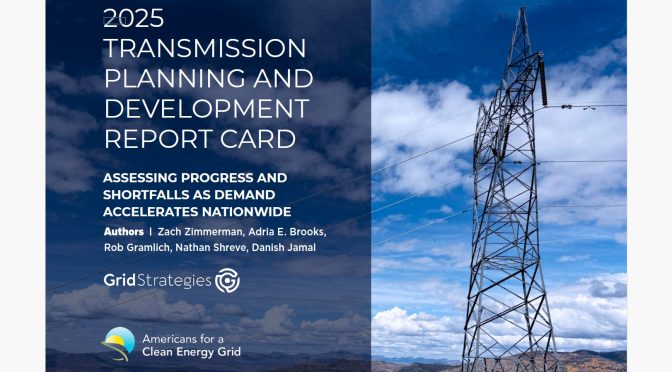
The new 2025 Transmission Planning and Development Report Card from Americans for a Clean Energy Grid (ACEG) delivers a candid assessment of where U.S. transmission planning stands – and where it falls short. The findings are clear: while incremental improvements are underway, the pace of reform still lags the explosive growth in electricity demand driven by data centers, electrification, manufacturing reshoring, and extreme weather resilience needs. Regions that embrace proactive, long-term, scenario-based planning are beginning to pull ahead, but interregional transmission remains one of the weakest links in the national grid strategy.
The report highlights two themes that are especially important for utilities and planners. First, long-term planning under FERC Order No. 1920 is beginning to reshape regional processes, requiring 20-year outlooks, multi-value benefit assessments, and evaluation of Advanced Transmission Technologies (ATTs) including high-performance conductors. Second, despite compelling evidence that interregional transmission can deliver outsized reliability and affordability benefits, most regions continue to underinvest in cross-boundary capacity, leaving congestion and resilience value on the table.
At the same time, the report underscores a critical reality: demand growth forecasts have surged dramatically in just a few years, compressing planning timelines and increasing the stakes for infrastructure decisions. In this environment, simply planning more lines is not enough. Utilities must build smarter – maximizing transfer capability within existing rights-of-way and deploying high-capacity solutions that can be delivered within realistic timeframes.
This is where Advanced Conductors become central to modern transmission strategy. Order No. 1920 explicitly calls for consideration of High Performance Conductors alongside traditional upgrades – recognizing that reconductoring and uprating can unlock substantial incremental capacity without waiting a decade for new corridors to clear permitting. Compared to conventional steel-core conductors, composite-core Advanced Conductors such as ACCC® Conductor deliver higher ampacity, lower thermal sag, and reduced losses – enabling more power delivery within the same structures. That combination directly supports several of the multi-value benefits emphasized in the report: reduced congestion, improved reliability margins, resilience under extreme weather, and reduced transmission energy losses.
In short, the ACEG Report Card reinforces what forward-looking utilities already understand: planning reform is necessary, but it must be matched by physical grid modernization. As load growth accelerates and reliability pressures intensify, upgrading existing corridors with proven Advanced Conductor technology offers one of the fastest, most cost-effective tools available to close the gap between policy ambition and operational reality. The age of incrementalism is ending. Transmission performance – and the materials that enable it – will define whether the grid can keep up with America’s accelerating electric future.