The electrical grid is being reshaped by powerful forces: aging infrastructure, climate-driven stress, a rapidly expanding portfolio of renewable and distributed generation assets, and the surging power demands of AI and data centers. For utilities tasked with strengthening and expanding transmission capacity, the question of which conductor to use has become more strategic than ever.
This decision, while seemingly routine, plays a pivotal role in determining how efficiently, reliably, and sustainably the grid can meet the demands of the future.
Moving Beyond Legacy Designs
For decades, traditional steel-reinforced conductors like ACSR and ACSS have been the workhorses of the transmission industry. ACSR, developed over a century ago, combines hard-drawn aluminum with a galvanized steel core. The aluminum carries current and provides some tensile strength, while the steel adds mechanical support. However, above 93°C, ACSR begins to lose structural integrity as the aluminum anneals, making it unsuitable for modern high-temperature operation.
ACSS addressed this challenge by replacing hard-drawn aluminum with fully annealed aluminum, capable of continuous operation at 200°C – and even 250°C with specialized coatings. While this change improved thermal performance, the underlying steel core still presents limitations. Steel is heavy, prone to corrosion, and expands significantly with heat, leading to increased sag under high loads.
Incremental Improvements, Persistent Constraints
To improve upon traditional designs, manufacturers have introduced ultra-high-strength steel-core conductors with tensile strengths up to 285 ksi and beyond. These “enhanced” steel-core conductors allow higher tension and reduced sag, and some designs reduce the steel core size slightly to accommodate more aluminum, increasing efficiency.
However, these modifications still rely on steel, which brings with it a high coefficient of thermal expansion (~19 x 10⁻⁶/°C). No matter how strong the steel, it expands significantly when heated, causing sag that must be mitigated through structural design or limited operating conditions. Enhanced steel cores are a step forward – but they remain bound by the inherent limitations of steel itself.
A Fundamental Shift: Composite Core Technology
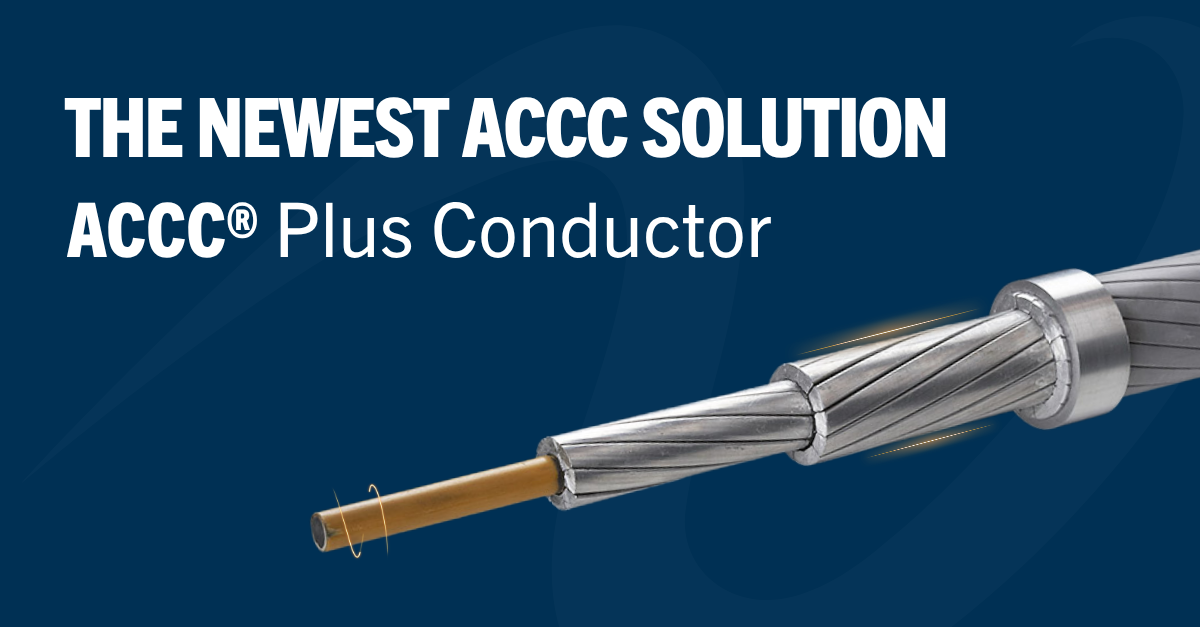
In 2005, a new conductor architecture emerged – one that redefined what’s possible in overhead transmission. The ACCC® Conductor introduced a lightweight, high-strength carbon fiber composite core bonded in a thermally stable epoxy matrix. This wasn’t just a stronger core – it was a fundamentally different material.
With a tensile strength over 313 ksi and a CTE of just ~1.6 x 10⁻⁶/°C, the composite core eliminates the steep sag curves associated with steel. Its density – only 117 lb/ft³ – is about 70% lighter than steel, enabling significantly more aluminum to be added for increased ampacity without increasing conductor weight or diameter.
The result: a conductor that runs cooler, sags less, and carries more power—without requiring structural modifications.
Extending the Advantage: ULS and AZR™ Variants
The innovation didn’t stop there. In 2015, the ACCC® ULS™ (Ultra-Low Sag) core was introduced, pushing tensile strength beyond 375 ksi and reducing CTE to as low as 0.75 x 10⁻⁶/°C. Designed for long spans, rugged terrain, and extreme weather, the ULS core delivers superior thermal and mechanical performance.
For regions prone to ice and wind loading, the ACCC® AZR™ conductor incorporates Aluminum-Zirconium (Al-Zr) alloy strands, offering higher tensile strength and better resistance to annealing compared to fully annealed aluminum. This allows the conductor to maintain elasticity and sag performance in harsh conditions.
The ACCC® ULS AZR™ variant brings these technologies together, offering unmatched sag control and resilience – even under the most demanding operating conditions.
Steel vs. Composite: Why It Matters
At the heart of the conductor choice is physics.
Steel expands nearly 10x more than carbon composite under heat. It’s heavier, susceptible to corrosion, and cyclic load fatigue. Composite cores, in contrast, are lighter, stronger, non-conductive, and thermally stable. These advantages translate into higher ampacity, lower line losses, and superior sag control – all while maintaining or reducing conductor diameter.
“Enhanced” steel-core conductors may increase tensile strength or adjust strand geometry, but they can’t overcome the limitations imposed by the material itself. By shifting to composite, utilities can design for the future – not the past.
What the Grid Needs Now
With right-of-way constraints, rising loads, increasing climate risks, and urgent decarbonization goals, utilities need transmission solutions that go beyond incremental improvements. They need conductors that fundamentally change the performance equation – delivering more power with less loss, greater reliability, and longer service life.
That’s what advanced conductors built on composite core technology make possible.
Because if it runs hotter and sags more, it’s not truly advanced.