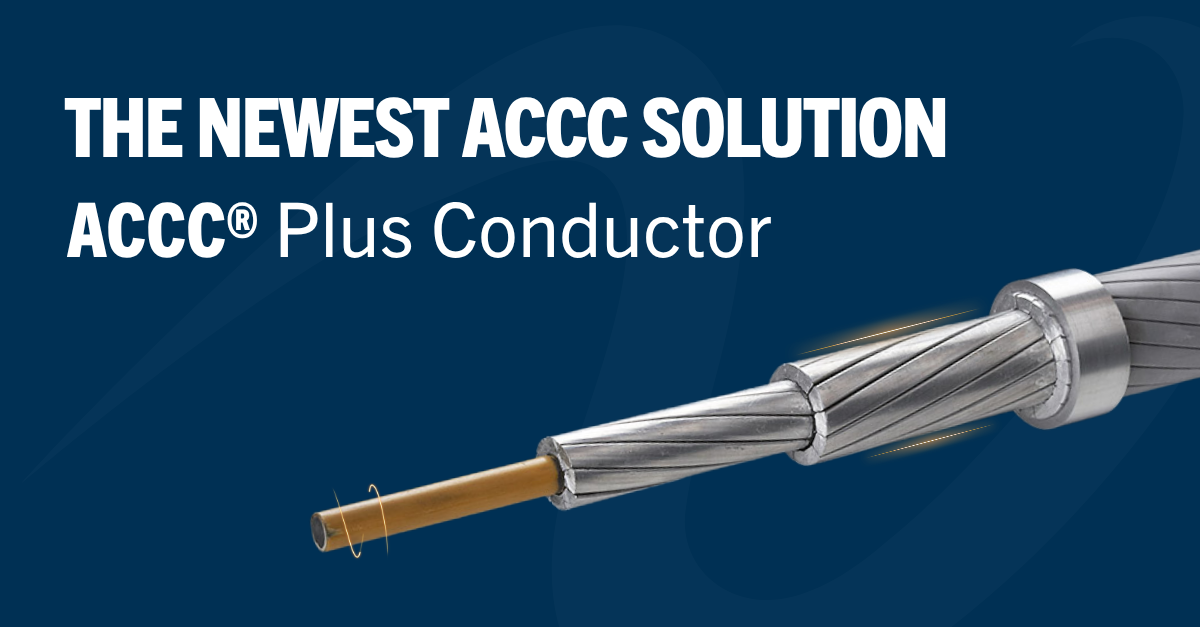
As utilities worldwide embrace advanced composite core conductors to improve transmission efficiency, capacity, and reliability, one critical element often overlooked – but absolutely central to performance and safety – is the hardware system that anchors these conductors to the grid.
Unlike conventional steel-reinforced cables, composite core conductors such as CTC Global’s ACCC® Conductor cannot be safely terminated using traditional steel-compatible fittings. Suggesting otherwise is both misleading and dangerous. Yet, a number of newcomers to the market have begun making precisely that claim – insisting that their composite conductors can be installed with little training, using “conventional” hardware, as though the core material did not matter.
This narrative is not just naïve; it puts projects, assets, and people at risk.
The Challenge: Anchoring a Composite Core
Traditional ACSR and ACSS conductors use a steel core that yields plastically under stress. When overloaded or deformed, the steel wire simply takes a permanent set. That tolerance for abuse is one reason conventional fittings could rely on brute-force compression, clamps, or swages.
Composite cores, by contrast, behave very differently. They are fully elastic: they do not plastically deform or “take a set” like steel. Instead, they carry load elastically, meaning stresses must be carefully managed. If improperly gripped, a composite core can stretch excessively, concentrate stress in one region, or suffer microfractures – failure modes that are not visible during installation but can emerge under service conditions.
This difference is fundamental. Treating a carbon composite core like a steel wire is not just bad practice – it’s a direct path to premature failure.
The Proven Solution: The Collet System
CTC Global’s patented collet hardware system was developed precisely to address this challenge. Much like a precision machine-tool chuck, the collet surrounds the composite core with segmented gripping elements. When drawn into a tapered housing, the collet applies a uniform radial load using axial force, distributing stress evenly around the circumference.
The result: the composite core is securely anchored without crushing, kinking, or creating stress concentrations. Just as importantly, the collet system accommodates the elastic stretch behavior of the composite. It allows the core to elongate under load and then recover without inducing excessive localized strain – something no conventional steel-based fitting can provide.
Field-Proven Reliability
This is not theory. More than 1 million collet-based fittings have been installed on ACCC® Conductors worldwide. The result: zero reported field failures.
For utilities, this track record is not just comforting – it is essential. Transmission hardware failures carry enormous costs, including grid instability, unplanned outages, and safety risks. The collet system’s proven reliability removes this risk factor, allowing utilities to deploy composite conductors with confidence.
The design has also passed the industry’s most rigorous independent tests, including ANSI C119.4/7, IEC 61284, and EPRI’s 1,500 thermal cycle protocol – among several others. Major accessory manufacturers such as Preformed Line Products (PLP), AFL, and DMC Power have incorporated collet technology into their dead-ends and splices. CTC Global actually has 11 certified ACCC® Hardware suppliers, worldwide.
Why “Conventional Hardware” Claims Are Dangerous
Some new market entrants are now claiming their composite core conductors can be installed quickly with standard steel hardware and minimal training. This is a false and reckless message.
Such claims ignore both the unique mechanical behavior of composite materials and the fact that elastic structures require precision load transfer. Using conventional fittings not only risks damaging the core during installation but also sets up long-term failure risks under thermal cycling, high loads, or emergency operating conditions.
Utilities should recognize this narrative for what it is: an attempt to make adoption sound “easier” at the cost of long-term reliability and safety.
The System-Level Perspective
Composite conductors deliver benefits – higher ampacity, lower losses, reduced thermal sag – that are only realized if the entire system is designed to support them. Hardware is the bridge between the line and the structure, the weak link if improperly engineered.
The collet system ensures that advanced conductors deliver their full performance safely. By accommodating the elastic stretch and recovery of the composite core, it provides the mechanical integrity required for decades of reliable service. Without it – or without equivalent engineered solutions – the composite revolution would stall under the weight of premature failures and utility mistrust.
The Bottom Line
The grid cannot be upgraded with shortcuts. Composite core conductors are not simply “stronger wires” that can be terminated with the same hardware used for steel. They require – and deserve – precision-engineered solutions that respect the unique properties of the material.
CTC Global’s collet hardware system has already proven itself in the field, time and again, across continents and climates. It is not a complication; it is the enabler.
Those who suggest otherwise are not offering utilities an easier path. They are offering them a hidden liability.